List of Top 10 Best Law Colleges in Delhi NCR for LLB in 2026
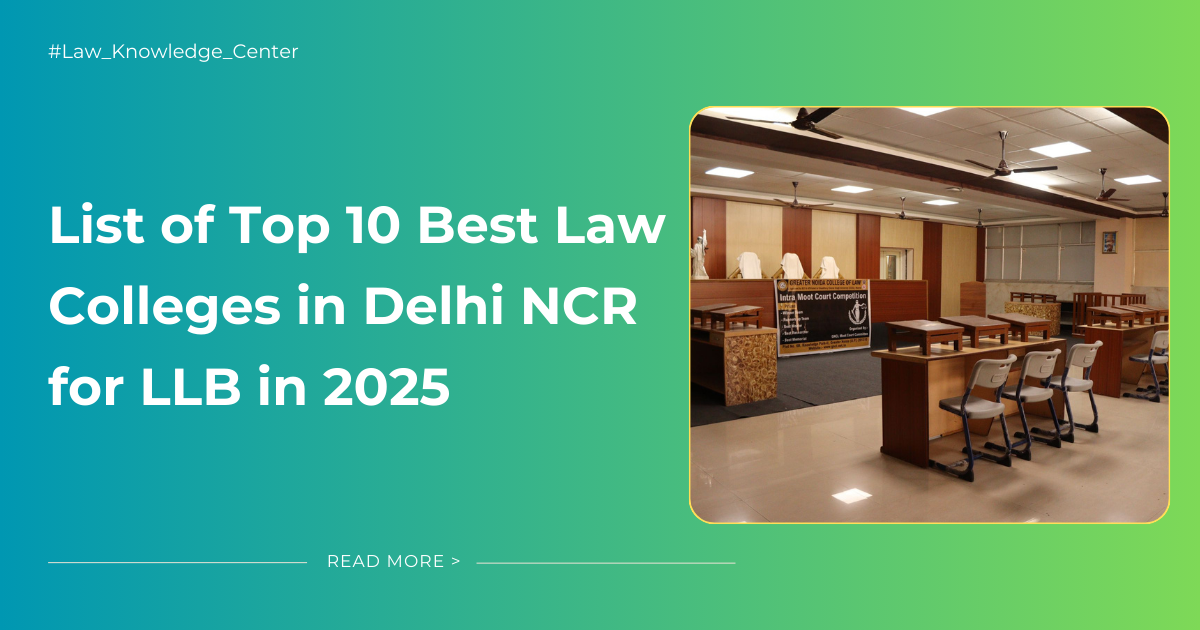
Top Law Colleges in Delhi NCR for LLB: Admission, Fees, Placements & Career Scope
Choosing the right law college is the first step toward building a successful legal career. Whether you dream of becoming an advocate, corporate lawyer, legal advisor, or judicial officer, the quality of your legal education plays a significant role in shaping your future.
Delhi NCR has emerged as one of India's leading education hubs, offering students access to reputed law colleges, experienced faculty, modern infrastructure, and excellent internship opportunities. However, with so many institutions available, selecting the right college can feel overwhelming.
This guide highlights the key factors to consider while choosing an LLB college and explains why Delhi NCR continues to be a preferred destination for legal education.
Why Study Law in Delhi NCR?
Delhi NCR offers students a unique learning environment where academics meet practical legal exposure. The region is home to district courts, the Delhi High Court, the Supreme Court of India, law firms, corporate offices, government organizations, and legal research institutions. This provides students with valuable opportunities to gain practical experience during their studies.
Some of the major advantages include:
- Experienced faculty members
- Modern classrooms and digital libraries
- Moot court facilities
- Internship opportunities with law firms and legal organizations
- Placement assistance
- Better networking opportunities within the legal profession
What Makes a Good Law College?
Before applying for admission, students should evaluate several important factors rather than relying only on rankings.
Bar Council of India Approval
Ensure the college is approved by the Bar Council of India (BCI). This recognition is essential for students who wish to practice law professionally after completing their degree.
Experienced Faculty
A strong faculty team helps students understand legal concepts through practical examples, case studies, and courtroom-based learning.
Practical Learning
Legal education is more than classroom lectures. Look for colleges that encourage participation in:
- Moot court competitions
- Legal aid camps
- Court visits
- Research projects
- Seminars and workshops
Internship Opportunities
Internships help students understand how the legal profession works. Exposure to law firms, corporate legal departments, NGOs, and courts strengthens practical knowledge and improves employability.
Placement Support
A good law college should provide placement assistance through industry partnerships, campus recruitment drives, career counseling, and professional development programs.
Key Statistics of the Best Law Colleges in Delhi NCR
Below are some of the key statistics that all law aspirants should know about before researching the best law colleges in Delhi NCR. The document below will serve as a guide for what you should expect from the law colleges in Delhi NCR:
|
Best Law Colleges in Delhi NCR: Key Statistics 2026 |
|
|
Number of Law Colleges in Delhi |
200 |
|
Fee Structure |
Less than INR 1 lakh: 55 colleges |
|
INR 1-2 lakh: 60 colleges |
|
|
INR 2-3 lakh: 32 colleges |
|
|
INR 3-5 lakh: 35 colleges |
|
|
More than INR 5 lakh: 43 colleges |
|
|
Top Areas of Specialization |
Constitutional Law |
|
Corporate Law |
|
|
Criminal Law |
|
|
Business Law |
|
|
Intellectual Property Law |
|
|
Accepted Entrance Exams |
CLAT |
|
LSAT India |
|
|
AILET |
|
Top 10 Best Law Colleges in Delhi NCR for LLB in 2026
Delhi NCR is home to over 200 law colleges offering a wide range of undergraduate, postgraduate, and doctoral programs. Students can choose from courses such as LLB, BA LLB, BBA LLB, BCom LLB, BSc LLB, LLM, LLD, and other specialized legal studies. Among these institutions, around 140 are privately managed, more than 30 are government-owned, and a few operate under public-private partnerships.
Admission to law programs after Class 12 is generally based on national and university-level entrance examinations such as CLAT, CUET, CUET PG, and LSAT India, depending on the institution and course. Some of the leading law institutions in the region include Amity University Gurugram, Indian Law Institute (ILI), Guru Gobind Singh Indraprastha University (GGSIPU), Jamia Millia Islamia, and National Law University (NLU) Delhi, all of which are recognized for their quality legal education and academic excellence.
|
College Name |
NIRF 2024 |
Courses |
Eligibility |
Fees |
|
National Law University Delhi |
2 |
BA LLB LLM |
Graduation: 50 % Exams: AILET |
₹ 1.35 - 1.42 L |
|
Faculty of Law, JMI |
6 |
BA LLB |
Graduation: 50% Exams: JMI Entrance Exam |
₹ 1 - 4L |
|
GGSIPU |
17 |
BA LLB BBA LLB |
10+2: 50 % Exams: CLAT, IPU CET |
₹2.7 - 14.2 L |
|
Indian Law Institute ILI |
35 |
LLM |
Graduation: 50% Exams: CLAT |
₹ 1.4 L |
|
Amity University Gurugram |
33 |
BBA LLB BA LLB B. Com LLB LLM |
10+2: 50 % Exams: CUET UG |
₹ 10.9 |
|
Amity University Noida |
49 |
BBA LLB BA LLB B. Com LLB LLM |
10+2: 60 % Exams: CUET |
₹8.6 - 19 L |
|
Gautam Buddha University, Greater Noida |
|
BA LLB LLM |
10+2: 45 % Exams: CBSE |
₹ 2.4 – 9 L |
|
Greater Noida College of Law |
|
BBA LLB B. Com LLB LLB |
10+2: 45 % Exams: CBSE |
INR 1.8 - 3.58 L |
|
Faculty of Law, University of Delhi, |
|
LLM LLB BA LLB |
10+2: 50% Graduation: 50 % Exams: CUET-PG, DUET |
INR 18K |
|
Amity Law School, Noida |
|
BA LLB |
10+2: 45 % Exams: CBSE |
14.2 |
Best Government Law Colleges in Delhi NCR for LLB
The list of the best law colleges in Delhi NCR owned by the Government, together with their total tuition costs, is displayed in the table below.
|
Public College |
Total Tuition Fee |
Eligibility / Exams |
|
NLUD |
INR 30,000- INR 6.75 lakh |
AILET and Merit-Based |
|
GGSIPU |
INR 70,000 - INR 4 lakh |
CLAT, IPU CET |
|
ILI |
INR 10,000- INR 1.4 lakh |
Merit-Based |
|
DU |
INR 18,060 |
Merit-Based |
|
CCSU |
INR 70,000 - INR 1.5 lakh |
Merit-Based |
|
Faculty of Law JMI |
INR 17,400 - INR 2.02 lakh |
JMI Entrance Exam |
Top Private Law Colleges in Delhi NCR for LLB
The top private law colleges in Delhi NCR are included in the table below, along with the total cost of tuition.
|
Private Colleges |
Eligibility / Exams |
Fees |
|
Amity University Gurugram |
CUET, Merit-Based |
INR 82,000- INR 10.9 lakh |
|
Amity University Noida |
CUET, Merit-Based |
INR 1.3 lakh- INR 18.6 lakh |
|
IMS Law College |
Merit-Based |
INR 3.17 lakh - INR 6.99 lakh |
|
Chanderprabhu Jain College of Higher Studies and School of Law |
CLAT, CUET |
INR 1.06 lakh - INR 5.33 lakh |
|
Greater Noida College of Law |
CLAT, CUET |
INR 1.8 Lakh - INR 3.58 Lakh |
Tuition fees are approximate and subject to revision. Applicants should verify the latest fee structure on the official website of the respective institution.
Highest Salary Offered by Top Law Colleges in Delhi NCR
One of the key factors students consider while selecting a law college is the placement package and overall return on investment (ROI). Comparing tuition fees with the highest salary packages helps students evaluate the long-term value of pursuing a legal education from a particular institution. This comparison is especially useful when choosing between multiple colleges with similar academic offerings.
The table below highlights some of the leading law colleges in Delhi NCR, along with their average annual tuition fees and the highest placement packages offered to graduates.
|
College Name |
Total Tuition Fee |
Average Placement Package |
|
NLUD |
INR 30,000- INR 6.75 lakh |
INR 10 LPA- INR 19 LPA |
|
DU |
INR 18,060 |
INR 13.6 LPA - INR 15.5 LPA |
|
Greater Noida College of Law |
INR 1.8 Lakh - INR 3.58 Lakh |
INR 8 LPA – INR 14 LPA |
|
Campus Law Centre University of Delhi |
INR 12,040 - INR 18,030 |
INR 5 LPA - INR 14 LPA |
|
Fairfield Institute of Management and Technology |
INR 1.13 lakh - INR 4.13 lakh |
INR 10.8 LPA |
|
ILI |
INR 10,000 - INR 1.38 lakh |
INR 8.4 LPA |
|
M.D.U. Centre For Professional and Allied Studies |
INR 30,000 - INR 92,400 |
INR 0.5 LPA - INR 8.2 LPA |
|
LPU Admission Office |
INR 3 lakh - INR 12 lakh |
INR 8.05 LPA - INR 8.2 LPA |
Placement packages are indicative and may vary by recruitment year, employer, candidate performance, specialization, and market conditions. Candidates should refer to official placement reports for the latest information.
Best Law Colleges in Delhi NCR with Top Recruiters
Best law schools in Delhi NCR are broken down in the table below, along with their average placement packages and top recruiters:
|
College Name |
Average Placement Package |
Top Recruiters |
|
NLUD |
INR 10 LPA- INR 19 LPA |
Wipro, ICICI Bank, S&B Partners, Trilegal, Bajaj Finance |
|
DU |
INR 13.6 LPA - INR 15.5 LPA |
Capgemini, Paytm, Amazon, Google, Barclays, Dell, Indigo |
|
Greater Noida College of Law |
INR 8 LPA – INR 14 LPA |
TCS, AZB & Partners, Cyril AmarchandMangaldas, Khaitan& Co, Trilegal, Luthra and Luthra Law Offices |
|
Campus Law Centre, University of Delhi |
INR 5 LPA - INR 14 LPA |
United Lex, Seth Dua& Associates, Wadhwa Law Chambers |
|
M.D.U. Centre For Professional and Allied Studies |
INR 0.5 LPA - INR 8.2 LPA |
Samsung, ICIC Bank, Honda, Amazon, Infosys, Flipkart, |
|
LPU Admission Office |
INR 8.05 LPA - INR 8.2 LPA |
Bosch Ltd, CapeGemini, Ashok Leyland, Federal, Cognizant |
Top LLB Specializations Offered by Leading Law Colleges in Delhi NCR
Law colleges across Delhi NCR offer a diverse range of LLB specializations, allowing students to build expertise in specific areas of the legal profession. These programs are designed to meet the evolving demands of the legal industry and provide in-depth knowledge in emerging as well as traditional fields of law.
Some of the most sought-after specializations include Cyber Law, International and Trade Law, Human Rights Law, International Humanitarian Law, Corporate Law, Criminal Law, Intellectual Property Law, Constitutional Law, and Environmental Law.
The table below provides an overview of the popular LLB specializations available at leading law colleges in Delhi NCR.
|
Specialisation |
No. of Colleges |
Popular Colleges |
|
Corporate Law |
30+ |
GGSIPU, GNCL, VIPS, ILI, etc. |
|
Criminal Law |
20+ |
GGSIPU, GNCL, Jindal Global Law School, Amity University Noida, etc. |
|
Intellectual Property Law |
20+ |
ILI, Amity University Noida, GGSIPU, etc. |
|
Constitutional Law |
10+ |
Amity University Noida, GNCL, IILM University, Christ Campus, etc. |
|
Business Law |
10+ |
NLUD, Symbiosis Law School, Amity University, Greater Noida College of Law, K.R. Mangalam University, etc. |
Eligibility for LLB Admission
Admission requirements may differ from one institution to another, but most colleges follow similar eligibility criteria.
For a 3-year LLB program:
- Graduation from a recognized university
- Minimum qualifying marks as specified by the institution
For integrated law programs such as BA LLB or BBA LLB:
- Completion of Class 12 from a recognized board
- Required percentage according to the college's admission policy
Many institutions also consider entrance examination scores during the admission process.
Common Entrance Exams for Law Admission
Students planning to pursue legal education should stay updated with the entrance exams accepted by their preferred colleges.
Some widely recognized examinations include:
Preparing well in advance improves the chances of securing admission to a reputed law college.
Skills Every Law Student Should Develop
Success in the legal profession depends on more than academic performance. Students should continuously improve important professional skills such as:
- Critical thinking
- Logical reasoning
- Communication skills
- Legal research
- Analytical ability
- Negotiation skills
- Public speaking
- Problem-solving
These abilities become valuable throughout legal practice and professional growth.
Career Opportunities After LLB
An LLB degree opens doors to a wide range of career options across both public and private sectors.
Graduates can pursue careers as:
- Advocate
- Corporate Lawyer
- Legal Consultant
- Judicial Services Aspirant
- Legal Officer
- Compliance Officer
- Legal Researcher
- Public Prosecutor
- Policy Analyst
- Legal Advisor for Government Organizations
With additional specialization and experience, professionals can also build careers in arbitration, intellectual property law, taxation, cyber law, environmental law, and international law.
Tips for Choosing the Right Law College
Before making your final decision, consider these important points:
- Verify BCI approval.
- Review the curriculum and specialization options.
- Check faculty qualifications.
- Compare infrastructure and learning facilities.
- Explore internship opportunities.
- Review placement records.
- Understand the fee structure.
- Visit the campus if possible.
- Speak with current students or alumni.
- Compare multiple institutions before applying.
Taking time to evaluate these factors can help you make a well-informed decision.
Final Thoughts
Selecting the right law college is an investment in your future. Delhi NCR offers several institutions that combine quality education with practical legal exposure, making it one of the best regions for aspiring legal professionals.
Instead of focusing only on rankings, students should consider faculty expertise, infrastructure, internship opportunities, placement support, and overall learning experience. A college that encourages practical training, professional ethics, and skill development can prepare students for long-term success in the legal field.
Frequently Asked Questions
Q1. Which is the best place to study law in Delhi NCR?
Delhi NCR offers several reputed law colleges with quality education, experienced faculty, internship opportunities, and placement support. Students should compare institutions based on accreditation, infrastructure, faculty, and career opportunities.
Q2. Is BCI approval necessary for an LLB course?
Yes. Bar Council of India approval is essential for students who plan to practice law professionally after completing their degree.
Q3. What career options are available after completing an LLB?
Graduates can become advocates, corporate lawyers, legal consultants, compliance officers, legal researchers, judicial service aspirants, public prosecutors, or legal advisors in government and private organizations.
Q4. What should students consider before choosing a law college?
Students should evaluate BCI approval, faculty experience, infrastructure, practical training, internships, placements, fee structure, and student support services before taking admission.
About the Author
GN Group Editorial Team
Last Updated: 18/07/2026
The GN Group Editorial Team creates and reviews educational content related to admissions, entrance exams, career guidance, engineering, management, pharmacy, law, and higher education.
Every article is reviewed using official notifications from universities, entrance examination authorities, and regulatory bodies including NTA, UGC, AICTE, AKTU, GGSIPU, CCSU, PCI, and BCI wherever applicable.
Accuracy Notice: This article is intended for informational purposes. Admission dates, eligibility criteria, counselling schedules, and fee details may change. Readers are advised to verify the latest information through the respective university or examination authority's official website before making any decisions.
Leave A Reply